
Foundational research
In 2022, as agencies emerged from COVID and Remix began shifting from strategic planning toward service planning, I led the first baseline user research for Remix Transit.
The research combined in‑depth interviews, workflow mapping, and lightweight ethnography with planners and schedulers across agencies of different sizes. I focused on:
- how planning and service planning actually happen (tools, handoffs, hacks),
- where our current product fit into the broader ecosystem, and
- what organizational forces shaped adoption and impac
The outcome was a shared journey map and set of personas that:
- gave the product team a concrete way to orient around the transition from strategic planning to service planning,
- highlighted gaps and opportunities across the end‑to‑end planning lifecycle, and
- became an onboarding staple for new teammates to quickly grasp the complexity of our space.
“Pulsecheck” research
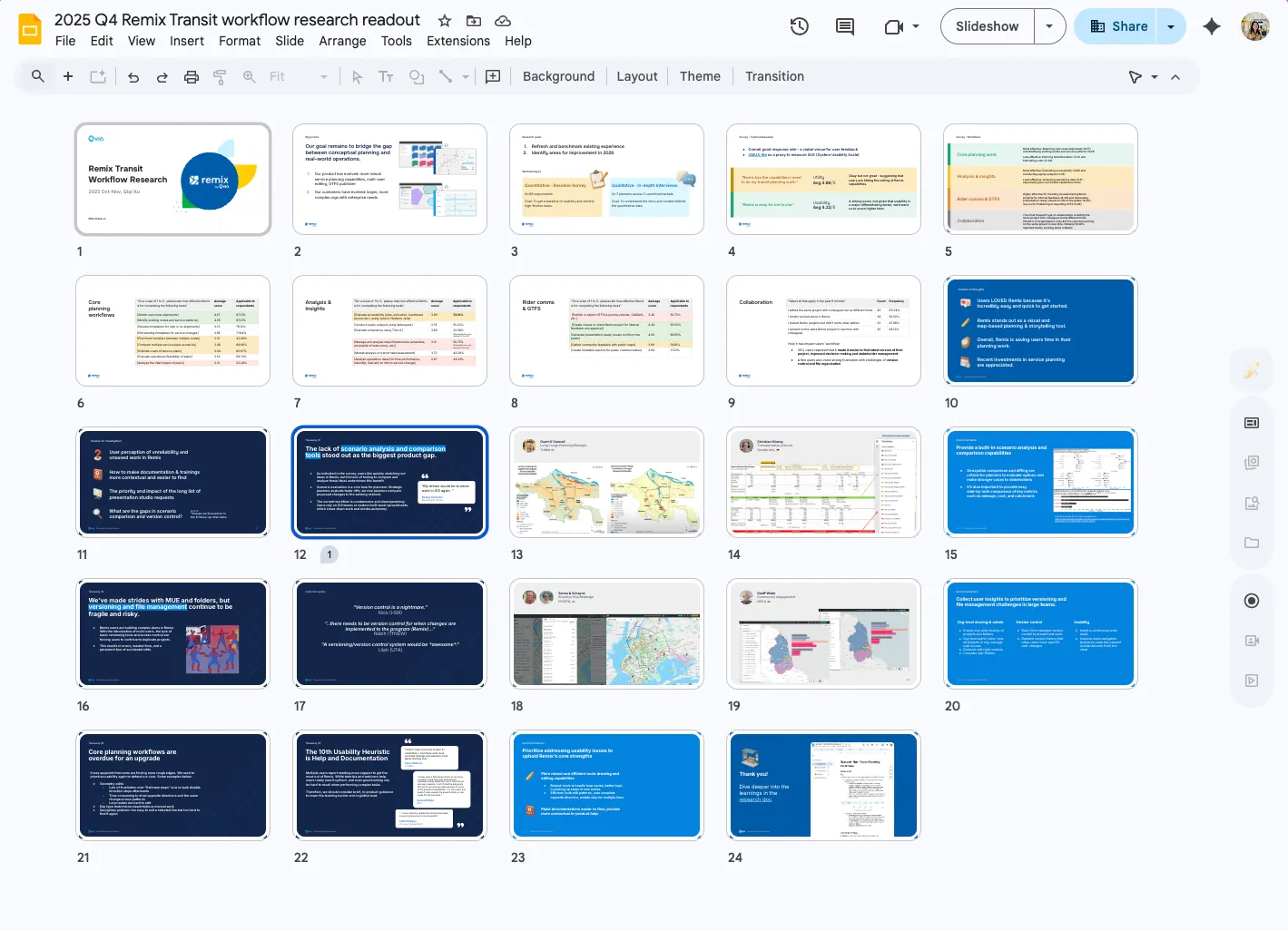
I refreshed and expanded this work again in 2025 to capture how our customers, their organizations, and their workflows had evolved. The findings of this research directly make themselves into the the 2026 strategy.
- The project’s goal was to benchmark the Remix experience and identify 2026 improvements.
- The process included a baseline survey (N=68) and in-depth interviews (N=7) with planners.
- The lack of built-in scenario analysis and comparison is the biggest product gap. Providing built-in scenario analysis will help planners evaluate options and make stronger cases to stakeholders.
- Fragile version control and file management are forcing users to duplicate their complex projects. Addressing this will prevent lost work and drastically improve collaboration workflows fr large teams.
- Key usability issues in core planning and documentation require a necessary and urgent upgrade, critical to uphold Remix’s core strengths
Research council
To make research a durable part of how Remix makes decisions, I initiated and facilitated a cross‑functional Research Council.
I designed the rituals, cadence, and artifacts for the council so that research would feel:
- lightweight enough for busy teammates to participate in,
- valuable enough that people would return, and
- visible enough that insights could travel beyond single projects.
Your interest and knowledge in the research space has the ingredients that are necessary to make good research habits stick across the org. By taking on facilitation of meetings and documentation, you’ve created the space and habits for people to return to when thinking about research. By bringing in your knowledge and resources like articles, frameworks, and examples of research, you’re making those meetings and async discussions a valuable place that people are getting something out of. This is key to making these rituals feel worthwhile and become habits.
Design Strategy and Vision work
Vision work is often hard to prioritize inside a roadmap. At Remix, I was able to secure time and alignment for month‑long strategic projects that helped us reframe product architecture and connect planning with operations — without promising a “big bang” redesign.
Product architecture rework
To meet an important customer commitment, we had introduced a new calendaring project type. It worked for the short term but left us with two overlapping project types, inconsistent workflows, and a more fragile long‑term architecture.
I proposed and led a month‑long strategic design project, later codenamed Redbird (because we are transit nerds), to revisit our product architecture. The core questions were:
- How can we support more complex service planning workflows without multiplying project types and exceptions?
- How do we design a structure that can grow with new user personas and organisational setups, instead of hard‑coding today’s assumptions?
The process combined synthesis of existing research (including the foundational work above), cross‑functional workshops, and speculative prototyping of alternative architectures. I deliberately framed it as one flexible transit project model that could serve a spectrum of user types and organizational contexts, rather than a catalogue of bespoke solutions.
The resulting vision
- simplified mental models for users (“one type of project, multiple layers of depth”),
- created a clearer path to elevate scheduling functionality in the future, and
- provided a strategic lens for evaluating incoming feature requests and sales commitments.
Redbird did not ship as a single “big redesign.” Instead, it acted as a north‑east star: a direction we could move toward incrementally, aligning decisions across teams while being transparent about trade‑offs.
Publishing North Star (2025)
As Remix matured into a platform that could handle more of the GTFS lifecycle, we reached another inflection point: how do we connect high‑level planning with the reality of live operations and data on the road?
I initiated and led a Publishing North Star project to explore this question across product areas, bridging planning and live operations.
Project goals
- to articulate a long‑term vision for how plans become operational data,
- to identify and connect related problems scattered across teams (data clarity, plan revision, collaboration), and
- to prepare the product for scenarios that did not yet exist fully in production (e.g. live operational data, new service types).
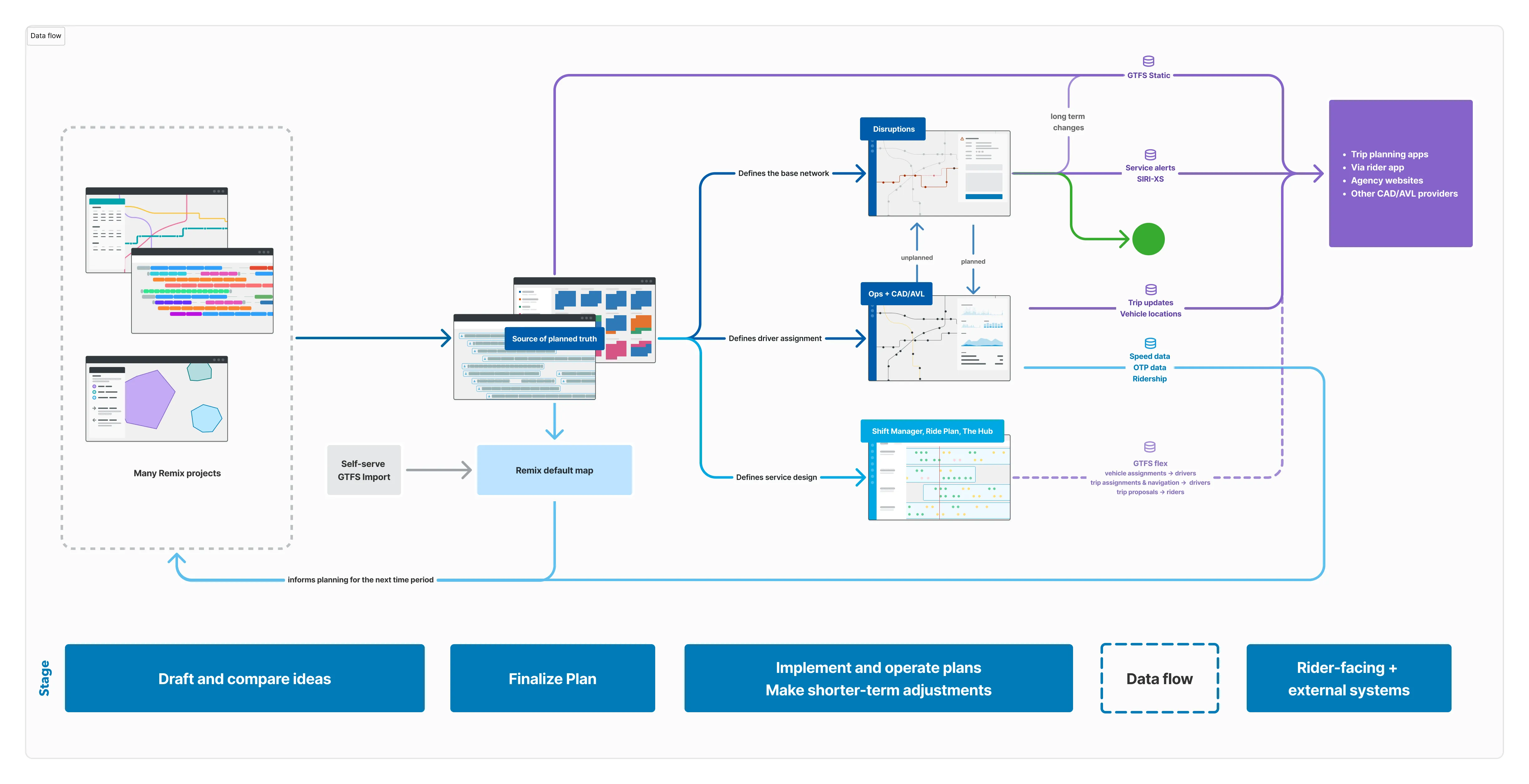
Through a mix of stakeholder interviews, system mapping, and scenario‑based design work, we identified three major UX gaps:
- Data clarity – teams struggled to see which plans were truly “operations‑ready” and which were experiments.
- Confident revision – revising a plan that was already partially implemented felt risky and opaque.
- Collaboration – responsibilities and handoffs between planning, operations, and external partners were often unclear.
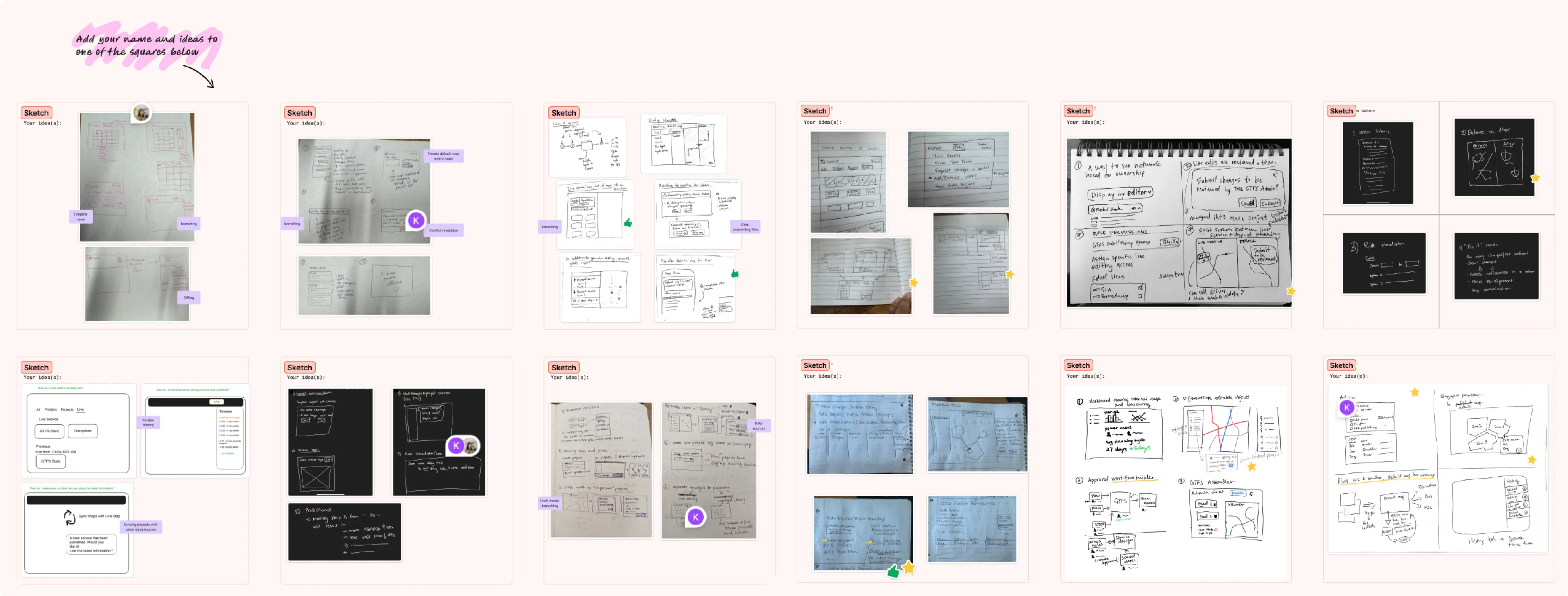
The North Star vision responded with both near‑term and long‑term moves, such as:
- clarifying and elevating operations‑ready plans within existing interfaces (already in progress)
- introducing draft modes and clearer review flows;
- sketching role‑based views and governance mechanisms for future iterations.
This work did not present a single “solution screen.” Instead, it framed publishing as a bridge between conceptual futures and situated realities — a theme I am interested in continuing to explore in a research‑oriented environment.